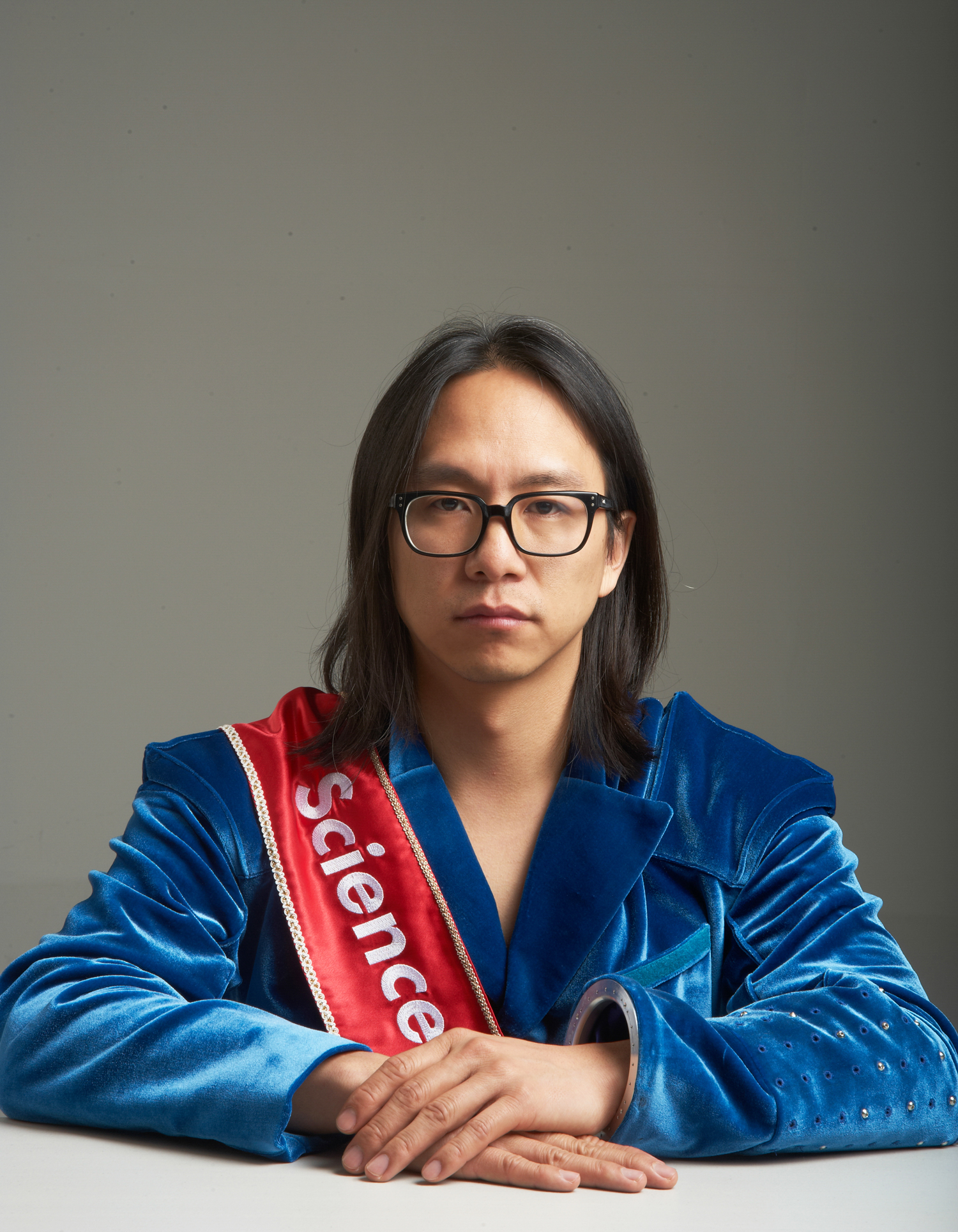
Hojun Song
b. 1978, South Korea
Hojun Song is an artist and engineer whose practice sits at the intersection of art, technology, and social commentary. Working across DIY engineering, performance, mass production, live streaming, and music, he creates absurd yet functional objects and systems that question how society constructs heroes, produces knowledge, and surrenders diversity to efficiency.
In 2013, Song launched OSSI-1 (Open Source Satellite Initiative) from Baikonur, Kazakhstan, the first satellite ever built and launched by an individual. Rather than celebrating the achievement, he turned the project into a critique of heroism and nationalism in science, funding it through T-shirt sales and documenting the process through performance and music. The satellite was less the point than the questions it raised: who gets to access space, and why do we need heroes to do it?
This skepticism runs through his entire body of work. The Strongest Weapon in the World (2007–2010) is an indestructible object that does not attack; when struck with a hammer, it says "I love you." Uranium Necklace (2010–2020) offers radioactive jewelry as a way to "taste death." LED That Blinks Once Every 100 Years (2010–2026), rejected by a committee that wanted it to blink annually, finally emitted its first light on January 14, 2026. The next blink is scheduled for 2126.
His ongoing series Don't Compress Me (2009–) is a global competition where participants move for 10 seconds to resist video compression algorithms. Random movements should defeat codecs like H.264, but humans consciously trying to be random cannot truly be random. The competition, held in Basel, Goa, Rome, Seoul, and Daejeon, is framed as a search for "a human who can live beyond the predictions of artificial intelligence." ANTI-A.I. Vocalization Techniques (2018) explores how we might fool speech recognition while remaining understandable to other humans.
Song's work extends into experimental music with dssb, a death metal duo formed in response to the 2014 Sewol ferry disaster, and gold & silver, an improvisation duo that charges negative admission so they can fail freely. Future School Food Foraging – Seaweed (2021), presented at the 17th Venice Architecture Biennale, connects Korean seaweed culture to climate change and diaspora. Time to Leave the Land (2020–2022) uses a sailboat as a floating studio for science fiction writing.
His work has been presented at the Venice Architecture Biennale, Poznan Mediations Biennale, Zero1 Biennial, Leeum Samsung Museum of Art, MMCA Seoul, and Art Sonje Center. He has spoken at MIT, RCA London, and Wired UK Conference, and has been featured in BBC, Wired, New Scientist, and Reuters.